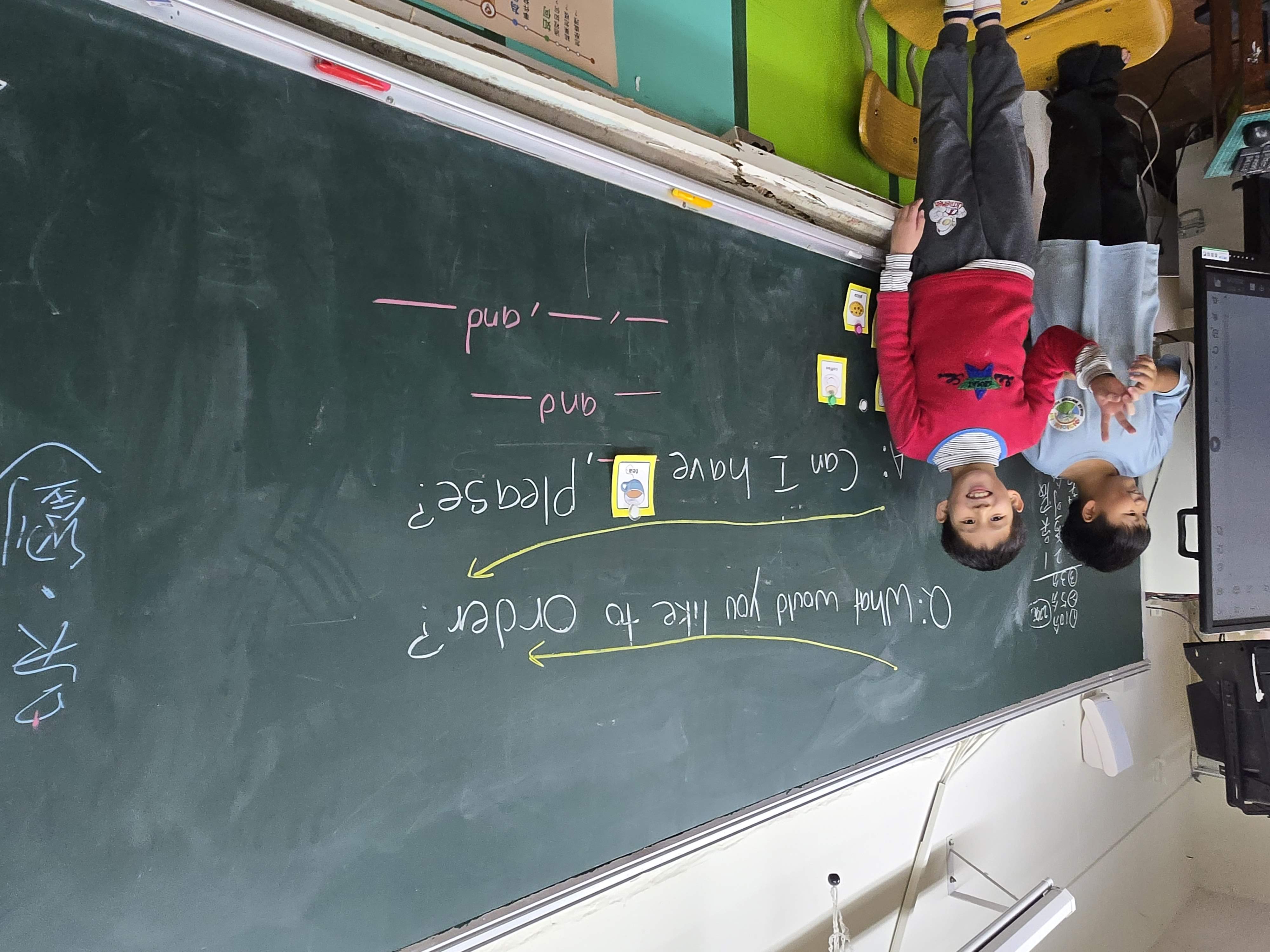
As of 2025, I've been exploring the question of what insights from theoretical linguistics can be applied in pre-university classrooms, to inform & transform (language) pedagogy — a line of work that is relatively underexplored in both linguistics and education spaces. Below are some of my recent output for K-12 students & teachers:
The above is from an English lesson I taught in 2025 at Shinkaie Elementary School (新開國小) in Miaoli, Taiwan. In this lesson, I superimposed a pitch contour (visualization of change in one's pitch) above sentences in question-answer pairs, and had students practice these together as dialogues, to build students' understanding of English intonation. See here for related local news coverage of my volunteering in rural Taiwan.
[Teaching Materials]
Course Description (taught with Professor Joshua Greene): In this GenEd course we’ll examine the evolution of morality on Earth, from its origins in the biology of unthinking organisms, through the psychology of intelligent primates, and into a future inhabited by machines that may be more intelligent and better organized than humans. First, we ask: What is morality? Many people believe that morality descends from above, as divine commands or as abstract, timeless principles akin to mathematical truths. Here we take an empirical approach to morality, viewing it as a natural phenomenon that rises up from below—born of the strategic interactions among lifeforms and societies struggling to exist. Next, we take a scientifically informed look at the foundational questions of moral and political philosophy. Many people believe that the “is” of scientific knowledge has nothing to do with the fundamental “oughts” of morality, that science and morality exist in separate realms (and belong in separate courses). Here we challenge this assumption, asking whether our scientific self-knowledge can, and should, change our views about what’s right and wrong and how a society should be organized. Finally, we consider the distinctive moral challenges posed by what may be the next stage in Earth’s evolutionary history: the rise of artificial intelligence. Many people believe that there is and always will be a fundamental division between human minds and machines. Here we challenge this assumption, going beyond the tropes of science fiction and drawing instead on the latest advances in cognitive neuroscience and neurally inspired artificial intelligence. Our conclusions will have implications for moral challenges of the near and more distant future: Can self-driving cars, military drones, and life-like robots be programmed to behave morally? Will artificial intelligence displace human labor? If so, how can our societies adapt? Could machines displace humans entirely? If so, how can we stay in control? If machines do take over, will they be our conquerors or our children? Across diverse topics, this course explores the implications of a single idea: that the wonder we see around us, and ahead of us, is the product of competition and cooperation at increasing levels of complexity.
[Teaching Materials]
Course Description (taught with Professor Nicholas Harkness): This course introduces students to a broad, complex view of language by relating ideas about language to linguistic structure and practice (i.e., language “use”). We take a fundamentally interdisciplinary approach, drawing widely from major findings and innovations in philosophy, linguistics, semiotics, anthropology, sociology, and literary studies—an approach that reflects in its hybridity the complexity of the problem. We also take a broadly multilingual, multicultural, and multiregional perspective. Readings and lectures will draw examples from a variety of languages and linguistic communities. The aim is to view the problem of language through many different perspectives. Throughout the course, we develop a set of powerful analytical tools for studying both language and culture and, ultimately, for defining their role in, and impact on, social life.
For examples of teaching materials, see
here,
here, and
here.
Course Description: Even though everyone speaks or signs at least one language, the complexity of language in its structure and function is often underappreciated and misunderstood. This myth-busting class guides students to the field of linguistics. Together, we will explore how language is structured from sound to conversation, how language is related to society, and how language is processed in the brain and simulated by machines. Students will engage with linguistic data, explore language technology, and reflect on their positions in the social world through ideologies about languages and their speakers. At the end of the class, with a taste for being a linguist, students will appreciate the skills and opportunities that linguistics can offer.